
'...especially pressure on the rupee, the current account deficit, and foreign exchange outflows.' 'The key question over the next several months is whether the government can prevent external turbulence from feeding into domestic economic pessimism.'

Even if there is an early agreement on a cessation of hostilities in West Asia, the price shock will not go away easily, points out A K Bhattacharya.

'Markets never fully lose hope. But an important shift could come if the Strait remains closed -- moving from high prices to no prices.'

Former Maldives President Mohamed Nasheed advocates for building democratic institutions over military intervention in resolving international conflicts, particularly in the context of the escalating West Asia crisis. He also discusses the impact of the conflict on the Maldives' tourism-dependent economy and calls for a stronger, more understanding India in the Indian Ocean Region.

Ashok Lahiri, a distinguished economist with experience in government, the private sector, and electoral politics, has been appointed as the new Vice-Chairman of NITI Aayog, tasked with strengthening India's reform trajectory and policy-making.

'...the enormous responsibility and faith the youth has put on his shoulders, that he is going to solve their problems.'

'Once the market decides it wants to go up, it goes up -- no amount of bad news can really hold it back.'

'Leadership is about understanding how a business works, how it is shaped, built, and expanded.'

'Even last year, when India bought gold, the physical quantity was much less than the previous years.'

OpenAI and Anthropic are not simply enabling new software capabilities, they are moving directly into enterprise execution, workflow ownership, and decision orchestration.

The Strait of Hormuz crisis is impacting lifestyles worldwide, from reduced gold purchases in India to energy conservation in Europe and Japan, as governments urge citizens to adapt to the global energy shock.
'At the first sign of real trouble, that money will move. There will be a run.'

The government is planning a postal logistics infrastructure upgrade for India Post to modernise parcel facilities, aligning them with those in developed nations, according to Communications Minister Jyotiraditya Scindia.

'If the Opposition associates itself too much with the minorities, then it becomes easy for the BJP to get Hindu consolidation votes.'

Telangana Chief Minister A Revanth Reddy will virtually deliver the keynote address at the Harvard Kennedy School's AI symposium, focusing on the global AI landscape.

'Nepal today is far more aware, self-confident, aspirational, and assertive.' 'India's policy so far has not been geared to this shift. It is time to redraw our Nepal strategy.'

Kara had the makings of a fine heist thriller anchored by a superlative Dhanush, but a slack screenplay in crucial stretches and an overdose of melodrama ensure it only works in patches, observes Sreeju Sudhakaran.

Trump seems to have estimated that Ghalibaf is a pragmatic politician who is receptive to close relations with the US and is enthusiastic about fostering business and economic ties in particular, points out Ambassador M K Bhadrakumar.

'A genuine tribute to Dr Ambedkar does not lie in selective invocation. It lies in asking a harder question: Is the Constitution still doing its job -- restraining even assertive majorities?' asks Manoj Mohanka.

Prime Minister Narendra Modi has accused the TMC government in West Bengal of 'maha jungleraj' following an incident in Malda where judicial officers were allegedly held hostage. He framed the upcoming elections as a battle between the TMC's 'fear' and the BJP's 'trust', promising accountability for alleged atrocities and a focus on development.

Trump has made it clear: the US will not lift its blockade of Iranian ports until a deal is signed.

'The reason why they rushed through the bill was they wanted to avoid using the 2026 Census because the 2026 Census by their own decision will be a caste census.' 'The BJP knows that a significant share of the OBCs who will get captured in the census, for the first time after the 1931 Census, are against the BJP. Only a segment of the OBCs are in their favour.' 'So they wanted to avoid the OBC reservation among women, which is a demand of a lot of Opposition parties.'
Prime Minister Narendra Modi has criticised the Trinamool Congress (TMC) government in West Bengal, citing the Malda incident as evidence of lawlessness and accusing the party of 'maha jungleraj'. He framed the upcoming elections as a battle between the TMC's 'fear' and the BJP's 'trust', addressing issues such as infiltration, corruption, and demographic change.

Both sides have now revealed a preference for escalation over strategic defeat, and each new provocation narrows the space for the next pause. The Touska seizure, Iran's refusal to negotiate under blockade, Israel's strikes on Iranian oil infrastructure -- all of these add up to an increasingly untenable situation. This makes the wild card -- Trump and his motormouth -- more consequential than ever, notes Prem Panicker in his must read blog on the Iran War.

Congress leader Shashi Tharoor discusses India's role in the US-Iran peace talks taking place in Islamabad, emphasising the importance of peace over competition with Pakistan and highlighting India's regional interests.

'Secularism or social development or social justice is no longer part of development, according to the youth in Kerala.' 'They are concerned about material wellbeing and material welfare, and they believe that Narendra Modi is capable to giving them that kind of development.' 'So, they don't have any ideological hesitation in voting for him.'
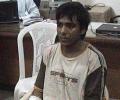
'The jail staff told me Kasab was served only jail food and not biryani.' 'They told me that Kasab was beaten regularly after court proceedings.' 'And they filled Kasab's bottle with urine so that whenever he felt thirsty he used to drink urine.'

The purge in Washington does not pause the war. Strikes continue, Hormuz remains closed, and Brent crude is still dancing around $109 a barrel. For India, the command chaos in the Pentagon is another layer of uncertainty piled on five weeks of conflict that was already straining every buffer Delhi has.

'In my entire career, whenever friends, relatives, or associates have sought my counsel, I have told them consistently: Stay away from equities. Buy gold. Place funds in fixed deposits. Acquire some raw land.' 'That is all one genuinely needs to build meaningful, enduring wealth, without the attendant anxiety of equity market participation.'

'We are profoundly energy-dependent on the Gulf. That dependency must now be redirected towards the United States, because we require American permission to procure oil.' 'We additionally require Iranian permission to acquire oil from that source. So India now has to seek two separate permissions merely to secure its energy supply.' 'Should we be compelled to source from America, or from Venezuela -- which is, in effect, American-controlled supply -- that will inevitably carry a price premium, an elevated shipping cost, and a considerably extended delivery timeline, given the distances involved.'

Israel has for more than two decades and several US presidencies worked to draw the United States into a full-scale war with Iran. Having finally achieved that, the last thing it wants is Trump declaring victory and going home, as he is prone to do. Ali Larijani was the figure most capable of handing Trump a negotiated exit with something to show for it. Without Larijani, the road to an exit gets considerably narrower. Prem Panicker continues his must read daily blog on the Gulf War.

'Was the five-day pause ever meant to hold, or was it simply another instrument of signaling, of positioning, of buying time in a war where even the pauses are tactical?' asks Prem Panicker in his must read daily blog on the Gulf War.

The pause gives the US time to breathe, to regroup, to move its expeditionary force into position without risk of interception along the way. It gives Iran nothing -- on the ground, attacks against its infrastructure continue apace. Prem Panicker in his must read daily blog on the Gulf War.
Karnataka Chief Minister Siddaramaiah emphasized the importance of ethical AI usage, intellectual property protection, and fair compensation in the AVGC-XR sector, advocating for AI to enhance human creativity rather than replace artists.

Iran is fighting a different war: Older, slower, and in some ways more dangerous. Iran doesn't need to shoot down an F/A-18. It only needs to make the Strait of Hormuz feel dangerous long enough for insurance markets, shipping companies, and oil futures traders to do the rest. Prem Panicker continues his must-read daily blog on the war in the Middle East.

'My argument was straightforward: If the Constitution allows this reservation and SC/ST and OBC candidates are already getting reservation in private institutions -- backed by Constitution Bench orders -- then not extending the same to EWS candidates directly violates the 103rd Amendment and Article 14, which guarantees the right to equality.'

Israel and the United States had a plan. Iran punched back. And now the Gulf is reeling, the world is beginning to feel the pain and, as on date, no one in Washington or Tel Aviv appears willing to admit that the punch has landed, notes Prem Panicker, continuing his must-read blog on the war in the Middle East.
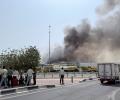
'In India, there is this first generation migrant, say from a small village in UP. He didn't go to the Gulf to buy a big house but make the life of his family better.' 'He may have paid 1 lakh rupees to an agent to go to the Gulf. Imagine what will happen to him and his family if he has to come back. He and his family will become poor again.' 'He went to the Gulf to come out of poverty, but this war will make his family trapped in poverty once again.'

'The BNP's election manifesto lists grievances against India, mirroring the attitude of past BNP governments.' 'Political parties have been careful not to say bad things about China.'

In the Indo-Pacific's new era -- where perception shapes reality faster than treaties -- the real entrapment is not of China or the United States. It is the test Japan has set for itself -- and whether partners like India, acting as balancers rather than accelerants, can help ensure that the story ends in stability, points out Varun Arya.
 © 2026 Rediff.com - Advertise with us - Disclaimer - Privacy Policy - Sitemap - Feedback - About us - Terms of use - Grievances